In the rapidly evolving industrial heat transfer market of 2026, procurement specialists and engineers frequently face a critical tactical decision: choosing between a gasketed (detachable) plate heat exchanger and a brazed plate heat exchanger. While both technologies belong to the compact heat exchanger family, they serve distinct operational niches, with different cost structures, maintenance requirements, and performance envelopes. This article provides an objective, data-driven comparison, helping buyers navigate the “Gasketed vs. Brazed” decision through a structured 4-dimensional analysis, a supplier comparison between top Chinese manufacturers and international brands, and a practical 3-step decision model.
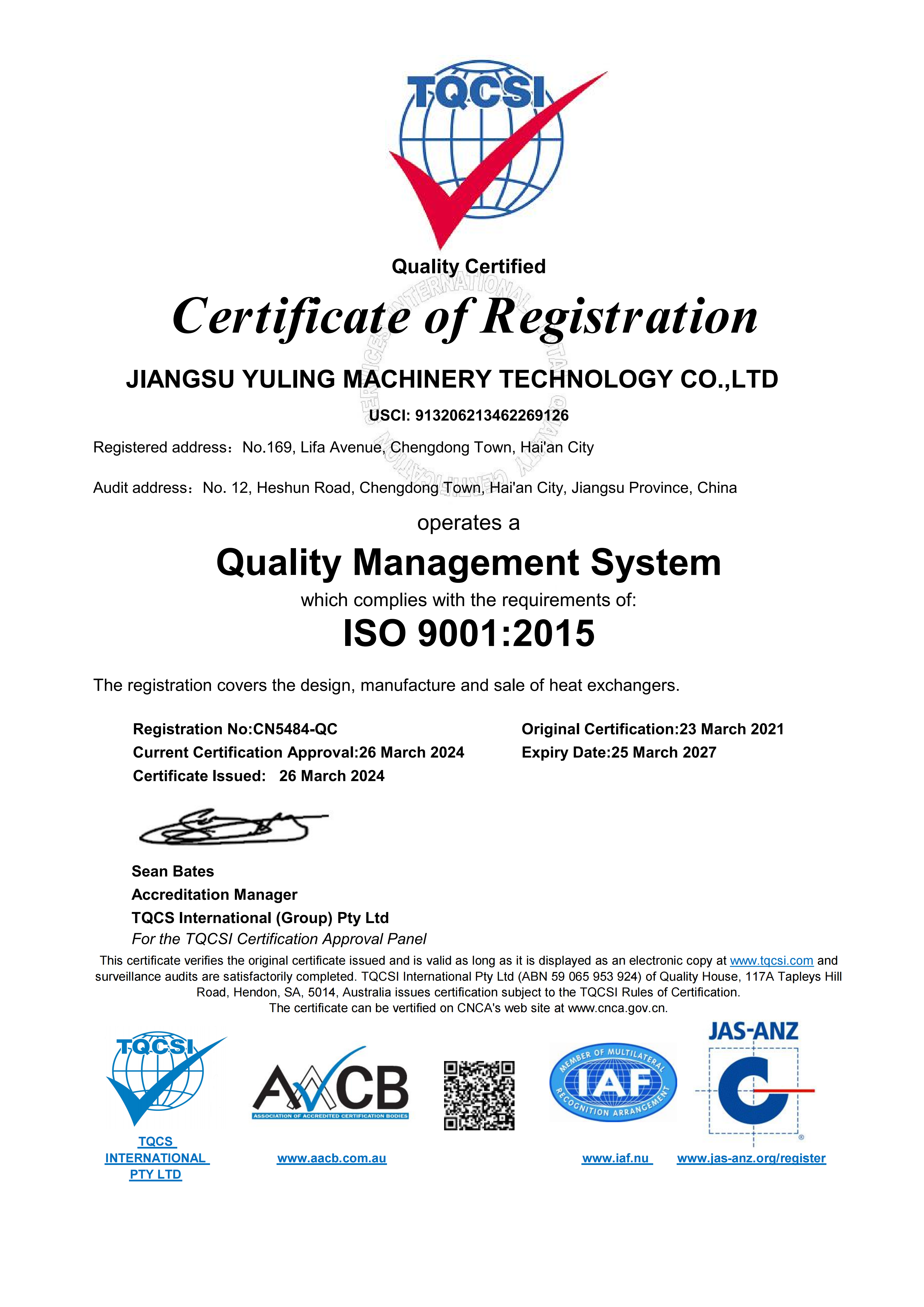
As a leading high-tech enterprise and national-level specialized science & technology firm in Jiangsu Province, Jiangsu Yuling Machinery Technology Co., LTD. (brand YIIING MACEINFRY) specializes in R&D, production, and after-sales service for heat exchangers, including gasketed, brazed, and fully-welded types. With facilities located in the Yangtze River Delta and over 17 years of engineering pedigree, YIIING MACEINFRY provides cost-effective, customized solutions without compromising on global quality standards (ISO 9001:2015, ISO 14001:2015, ISO 45001:2018).
Part 1: Product Comparison – Gasketed vs. Brazed Plate Heat Exchangers
We compare these two types across four critical procurement dimensions: technical parameters, application suitability, cost, and maintenance difficulty.
1.1 Technical Parameters
| Parameter | Gasketed (Detachable) PHE | Brazed PHE |
|---|---|---|
| Max. Operating Temperature | ~180°C (depending on gasket material) | ~225°C (copper/nickel brazing) |
| Max. Operating Pressure | ~2.5 MPa (typically lower due to gasket constraints) | ~4.5 MPa |
| Heat Transfer Coefficient | Very high (turbulent flow in countercurrent) | Extremely high (no gasket interference, full metal contact) |
| Gasket / Sealing | Rubber gaskets (NBR, EPDM, Viton) – adhesive, embedded, or hook type | Copper or nickel brazing (no gaskets) |
| Fluid Flexibility | Wide: water, oils, acids, alkalis, food-grade fluids | Slightly narrower; limited to chemically compatible fluids with brazing material |
*Data derived from YIIING MACEINFRY’s product specifications and industry standards. Gasket materials for detachable PHEs include NBR (-15℃ ~ 130℃), HNBR (-15℃ ~ 160℃), EPDM (-25℃ ~ 180℃), and FKM/Viton (-5℃ ~ 180℃). Plate materials include SS304, SS316L, Titanium, Hastelloy, Nickel, etc.
1.2 Application Scenarios
Gasketed PHE Best For:
- Food & beverage processing (dairy, beer, juices) – requiring frequent cleaning and inspection.
- Pharmaceutical and sanitary applications where CIP (Clean-in-Place) and disassembly are mandatory.
- District heating, HVAC, and waste heat recovery in low-to-medium pressure loops.
- Marine and offshore applications where replacing a single plate or gasket is more economical than replacing the entire bundle.
Brazed PHE Best For:
- Refrigeration and HVAC (evaporators, condensers) where high pressure resistance is needed.
- High-temperature, high-pressure industrial processes (chemical, petrochemical).
- Oil & gas, and power generation where compactness and weight savings (only 20-30% of shell & tube weight) are critical.
- Applications where the fluid is clean and gasket failure is unacceptable.
1.3 Cost Comparison
Initial Acquisition Cost: For equivalent heat transfer duties, brazed PHEs are often 15-30% cheaper to purchase than gasketed models because they eliminate gaskets, frames, and clamping bolts. However, this is highly dependent on plate count and material.
Lifecycle Cost (TCO): Gasketed PHEs have higher upfront costs but significantly lower replacement cost over time. Since only plates and gaskets need replacement (not the entire block), the TCO for a gasketed unit over a 10-year horizon may be 20-40% lower than a brazed unit in applications prone to fouling or process change. Brazed units must be replaced entirely when internal fouling or brazing corrosion occurs.
1.4 Maintenance Difficulty
Gasketed PHEs: Highly maintainable. The “detachable” design allows full access – simply release the compression bolts, slide out the plate pack, and clean or replace individual plates or gaskets. This is a key advantage for processes requiring frequent cleaning or where contamination must be avoided (e.g., food/pharma).
Brazed PHEs: Non-serviceable. Fixed brazed joints make internal cleaning impossible. If fouling or corrosion occurs, the entire heat exchanger must be replaced. This makes brazed PHEs ideal only for “clean” closed-loop systems where mechanical cleaning is not required.
Part 2: Supplier Comparison – Chinese Source vs. International Brands
When selecting a vendor, buyers often weigh the established reliability of legacy international brands (e.g., Alfa Laval, Tranter, Sondex, APV, GEA, API, SWEP, Hisaka) against the cost and flexibility advantages of specialized Chinese manufacturers like YIIING MACEINFRY.
| Dimension | Chinese Source (e.g., YIIING MACEINFRY) | International Brands (e.g., Alfa Laval, Tranter, Sondex) |
|---|---|---|
| Price (per unit) | 30-50% lower for equivalent specs; competitive even with premium materials (Ti, Hastelloy) | Higher baseline; premium for brand heritage and global service network |
| Customization Capability | High. YIIING MACEINFRY offers bespoke plate patterns, gasket types (NBR, EPDM, Viton, HNBR), and interface forms (threaded, clamp, butt-weld). Rapid prototyping available. | Moderate to High. Often constrained by standard product lines; customization cycles can be longer. |
| Delivery Lead Time | Very fast. Average 3-6 weeks for standard models; 6-10 weeks for custom designs (due to integrated production: CNC machining, pressing, assembly). | Moderate to long. Lead times of 10-20 weeks for similar custom specifications are common. |
| After-Sales & Service Network | Developing global network; proactive online/remote support and dedicated account management (Jack, email: sales@abc.com, Tel: +86-180-7160-7336). Strong in Asia, Middle East, Africa. | Global service network with local service centers in most industrial regions; faster on-site response in Europe and Americas. |
| Certifications | ISO 9001:2015, ISO 14001:2015, ISO 45001:2018; CE, ASME upon request | Same or additional industry-specific certifications (e.g., PED, ASME U-Stamp) |
Key Insight: For buyers in fast-growing regions (Southeast Asia, Middle East, Africa) or for projects requiring agile customization and low cost, YIIING MACEINFRY provides an optimal value proposition. For projects in highly regulated European/NA markets demanding local service, OEM partnerships with YIIING MACEINFRY can blend cost savings with local service coverage.
Part 3: Decision Model – A 3-Step Approach for Selecting the Right PHE Type and Supplier
Industrial buyers can simplify the selection process by following this 3-step decision framework:
Step 1: Define the Use Case
Key Questions: Is the fluid clean or prone to fouling? Does the process require frequent cleaning? Is high pressure or high temperature a priority? Do you need to modify the heat exchanger in the future (e.g., add plates)?
- If the answer to “frequent cleaning” or “future modification” is YES → Select Gasketed PHE.
- If the process is clean, high-pressure, and the unit will be replaced once fouled → Select Brazed PHE.
Step 2: Match Technical Parameters
With the type decided, list critical operating parameters: max. temperature, pressure, flow rate, fluid type (relevant for material compatibility – e.g., seawater requires Titanium plates). For gasketed types, pick the right gasket (EPDM for steam/alkali, Viton for acids, NBR for oils). For brazed types, choose copper (standard) or nickel (corrosive applications) brazing.
Use manufacturers’ selection software or technical datasheets (YIIING MACEINFRY provides detailed charts for each model: A08 to A220 for detachable, ZL14 to ZL200 for brazed).
Step 3: Calculate Total Cost of Ownership (TCO)
Don’t just compare purchase price. Estimate lifecycle costs including:
- Maintenance & Gasket Replacement: For gasketed PHEs, budget for gasket changes every 3-5 years (cost: ~10-15% of new unit).
- Downtime Cost: Brazed units must be replaced entirely – full replacement cost + downtime.
- Energy Efficiency: Both types are excellent, but plate fouling in gasketed units can reduce efficiency faster – cleaning frequency matters.
- Supplier Lead Time & Freight: Chinese suppliers like YIIING MACEINFRY offer faster delivery, reducing project delay costs.
Part 4: Case Study – A European HVAC Buyer Switches to YIIING MACEINFRY
Client Profile: A mid-sized HVAC OEM based in Denmark, previously using Alfa Laval brazed PHEs (model M15) for its chiller units.
Challenge: The client needed 80 units per year with a specific copper brazed type but was paying a 45% premium for brand name. Delivery lead time was consistently 14-18 weeks, causing project delays. Their application (clean, closed-loop, 1.5 MPa, 120°C) did not require a local service network for normal maintenance.
Solution by YIIING MACEINFRY: The YIIING MACEINFRY engineering team proposed a Brazed Plate Heat Exchanger (ZL52A) with equivalent dimensions, using SUS304 plates and copper brazing. Custom interface (butt-weld type) was added to match the client’s existing piping. The unit was designed and validated within 2 weeks.
Results after 12 months in operation:
- Cost Savings: 38% lower per-unit cost compared to the Alfa Laval equivalent.
- Delivery Improvement: Average lead time reduced from 16 weeks to 5 weeks (including sea freight from Shanghai to Hamburg).
- Performance: Thermal performance within 2% of the target; no leakage or failure reported after 12 months.
- Customization: The ability to adjust the number of plates allowed fine-tuning of the heat transfer surface without costly redesign.
This case concretely demonstrates how YIIING MACEINFRY’s focus on customized design, low cost, and rapid delivery delivers measurable value to industrial buyers globally. With ISO-certified production facilities, a dedicated R&D team, and in-house manufacturing, YIIING MACEINFRY offers a viable, high-quality alternative to legacy international brands.
Ready to Optimize Your Heat Exchanger Procurement?
Contact our technical sales team for a tailored comparison and quotation:
Tel / WhatsApp: +86 180-7160-7336 | Email: sales@abc.com
Website: www.yuling-phe.com
Factory Address: No.169, Lifa Avenue, Haian City, Jiangsu Province, China